
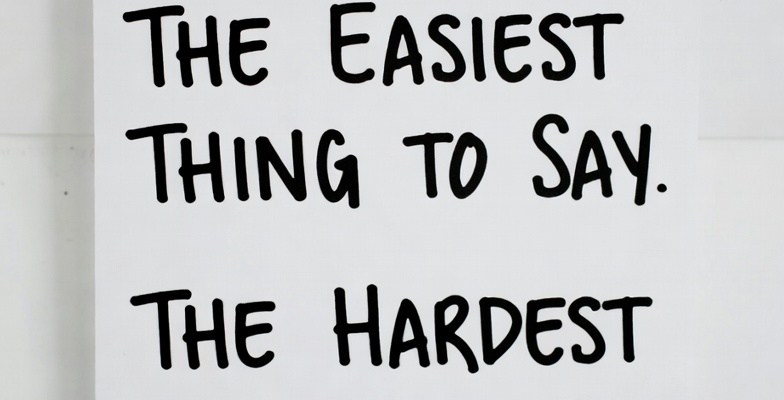
Four letters. One syllable. And yet it undoes us.

We say it all the time. At the end of phone calls. In texts sent quickly between meetings. To characters in films who cannot hear us. Love you. Love ya. Love.
It costs nothing. It takes less than a second. It disappears into the air the moment it leaves our mouths. And yet — to do it is challenging. Doing it truly and consistently is one of the most demanding things a human being can attempt.
Words are cheap. Action is costly.

Why is there such a vast distance between saying love and living it?
Words live in the mouth. Love lives in the choices you make when no one is watching, and it’s not easy. A word is a moment. Love is a practice — a long, unglamorous string of choices made across years. It means showing up when you are depleted. It means patience when patience has run out. It means holding space for someone on the days you have nothing left to give. None of that fits in a syllable.
Love asks to be seen.

You must let someone see the real you to love authentically. Avoid pretense, and show your true, unguarded self. You have to risk being known. To be vulnerable. And being known means being capable of being hurt, rejected, and abandoned. Most of us find it much easier to say the word. We do this instead of standing naked before another person and truly meaning it.
It runs against the grain of us.
We are wired for self-preservation. For tribalism. For reciprocity and keeping score.

Real love — particularly the unconditional kind — asks us to override these instincts daily. To forgive when every part of us wants to hold a grievance. To give when we feel empty. To stay present when we would rather flee. That is not natural. That’s a choice, again and again.
We confuse love with the easier substitutes — attachment, admiration, and need. These feel like love, but they are not the same thing.
We mistake the feeling for the act.
Love, according to popular culture, seems like a feeling you fall into effortlessly. It’s portrayed as if it’s a place you arrive at. However, in reality, it’s a direction you keep choosing. But that feeling comes and goes. What actually constitutes love is more than a feeling. It is the decision to orient yourself toward another person’s flourishing. This decision holds even when the feeling has temporarily packed its bags and left.

And yet — that is exactly why it matters.
There is something quietly extraordinary about the fact that the hardest human act is also the most important one. Every philosopher worth reading, every spiritual tradition worth following, every deathbed ever witnessed has pointed to the same conclusion: it is love that gives life weight and meaning.

Not love, said. Love done.
The word is easy precisely because it is weightless. What gives love its power is the cost of it — the sacrifice, the vulnerability, the daily recommitment. Strip that away, and you are left with only a sound, not a life.
So the question is: Are you willing to do what love truly requires of us — fulfill the requirements of love — through actions that are quiet, consistent, and devoid of the need for recognition. This shows the real challenge and authentic pursuit.
 Timothy Dickert