

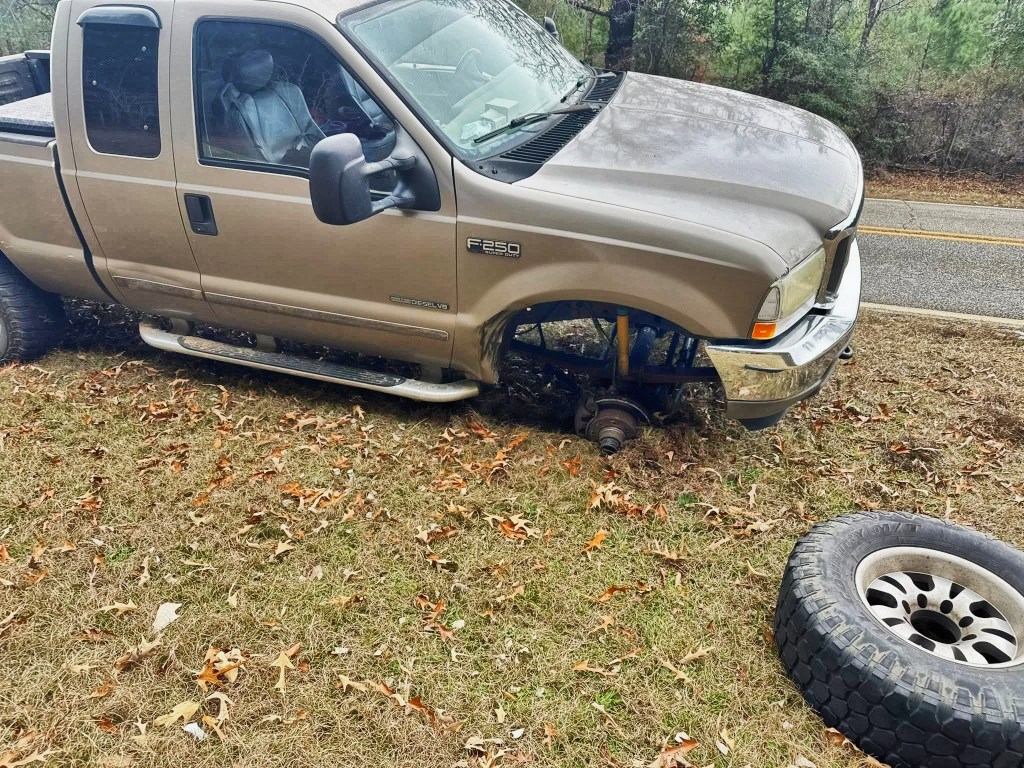
Yesterday, my good friend Scott had one of those moments that could have changed everything.
He was driving his Ford F-250, towing a trailer, when his passenger-side front tire just… came off. Not a blowout. Not a slow leak. The entire wheel separated from the vehicle.
If you’ve ever towed anything, you know how quickly this situation could spiral. Add a curve to the equation, and you’re looking at a potential disaster. Rollover. Injuries. Headlines. Funerals.
But here’s what I keep coming back to: none of that happened.
No rollover. No injuries. No headlines. No funerals.
When Scott shared what happened, he didn’t spiral into the “what ifs” or the “why me” that would have been so easy to grab onto. Instead, he said something that stopped me in my tracks:
“Gratitude isn’t pretending the bad didn’t happen.
It’s refusing to let the bad be the loudest voice in the room.”
I’ve been turning that sentence over in my mind ever since.
I have read the verse in 1 Thessalonians many times. Seeing Scott’s reaction provided a masterclass in action. “Give thanks in all circumstances.” Not for all circumstances—in them. This distinction is important.
Paul wasn’t telling us to be grateful that bad things happen. He was telling us that even in the middle of the mess, even when wheels are literally falling off, we can find a posture of thanksgiving.
Scott wasn’t thanking God that his tire came off. He was thanking God while dealing with a tire that came off. He was choosing gratitude while standing on the side of the road, looking at the damage.
It’s easy to obsess over the damage, the inconvenience, the disruption to plans. It’s natural to replay the moment and imagine all the ways it could have gone worse. Our brains are wired for that kind of worst-case-scenario thinking—it makes us habitually negative.
But Scott chose differently. He acknowledged the problem—the wheel came off, things went wrong, it’s a hassle—and then deliberately shifted his focus to what he was protected from. That’s not denial. That’s not toxic positivity pretending everything is fine when it clearly isn’t.
That’s gratitude with its eyes wide open.

The Psalms are full of this kind of honest-to-God wrestling.
David didn’t pretend everything was fine. He brought his complaints, his fears, his anger directly to God. But then—and this is the pattern you see over and over—he pivoted. “Yet I will praise You.” Not because the circumstances changed, but because he chose to remember God’s faithfulness in the middle of challenging circumstances.
I look at the photo of Scott’s truck sitting on the side of the road. The front end is damaged. A wheel is lying in the grass nearby. I see evidence of what didn’t happen.
He walked away. He’s telling the story. He’ll fix the truck.
Sometimes the miracle isn’t that nothing broke. It’s that you walked away when you shouldn’t have.
I am writing my first blog post of 2026. I can’t think of a better reminder to carry into this year. Life will throw problems at us. Wheels will fall off—literally and metaphorically. Things will go wrong at the worst possible times.

But we get to choose which voice is loudest in the room.
We get to choose how we respond.
We can let the damage, the inconvenience, the frustration dominate every conversation and every thought. Or we can pause, take a breath, and give thanks in the middle of it—not for the problem, but despite it.
Thank you, Lord, for the protection. Thank you, Lord, for your presence.
Thank you, Lord, for this perspective.
Scott chose gratitude. Scott decided to give thanks IN IT.
Watching him do it is a reminder. It’s something we all need to stay on top of as this new year begins.
The wheel fell off. And he’s still here to tell about it.
That’s worth being grateful for.
 Timothy Dickert